

The Difference Between AI Learners and AI Engineers
It’s not about models. It’s about systems.

AI Engineering Tech Stack (2026 Edition)
The AI conversation in 2026 is louder than ever.
New models launch every month. Benchmarks fluctuate by single-digit margins. Model comparisons dominate timelines.
But something important has quietly shifted.
The competitive edge is no longer about choosing the best model.
It is about designing the best system around it.
Most frontier models now operate within a narrow performance band.
The differences are often marginal.
What separates successful AI systems from experimental ones is not the model.
It is how data flows, how tasks are orchestrated, how constraints are enforced, and how outcomes are measured across the system.
In other words:
AI engineering has become a stack.
If you only focus on the model layer, you are optimizing one component in isolation.
Modern AI systems operate across multiple layers:
• Foundational environment and infrastructure
• Model selection and optimization
• Retrieval and knowledge integration
• Orchestration and agent design
• Deployment and inference efficiency
• Observability, governance, and ROI
Each layer influences the one above it.
Most learners stay stuck in the model layer.
Most value is created in orchestration and deployment.
Most business impact happens at the governance and ROI layer.
That is the shift.
This issue introduces the 2026 AI Engineering Tech Stack at a high level. In the coming weeks, we will break each layer down in detail.
If you want to move from experimenting with AI to engineering reliable systems, you need to understand how these layers connect.
The stack is becoming foundational.
It is the difference between demos and production systems.
Where Most Builders Get Stuck
Despite the explosion of AI tools, most builders cluster around a single layer of the stack.
The model layer.
They experiment with new LLM releases.
They compare benchmarks.
They tweak prompts.
They try different APIs.
And then they stop.
I see this pattern repeatedly in mentoring conversations and project reviews.
The result is a collection of demos — not systems.
This happens for three reasons.
First, models are visible. They are exciting. They change frequently. It feels productive to stay updated.
Second, models are accessible. You can test them in minutes. Deployment, orchestration, and governance require deeper engineering thinking.
Third, the industry conversation reinforces it. Social feeds talk about model launches. Very few talk about system design.
But here’s the reality:
Models rarely fail in isolation.
Systems fail.
Most AI projects break because:
• Data is unreliable or poorly structured
• Retrieval is inconsistent
• Orchestration logic is brittle
• Latency and cost are not optimized
• There is no monitoring or evaluation layer
In other words, the problem is rarely intelligence.
It is architecture.
And architecture lives across layers.
If you feel like you “know AI” but struggle to build something stable or monetizable, you are likely optimizing one layer while ignoring the rest of the stack.
Understanding where you are stuck is the first step toward engineering better systems.
So what does the full picture look like?
If AI engineering feels chaotic, it is usually because you are looking at one layer too closely.
Zoom out, and a pattern appears.
Modern AI systems operate across six interconnected layers. Each layer builds on the one below it.
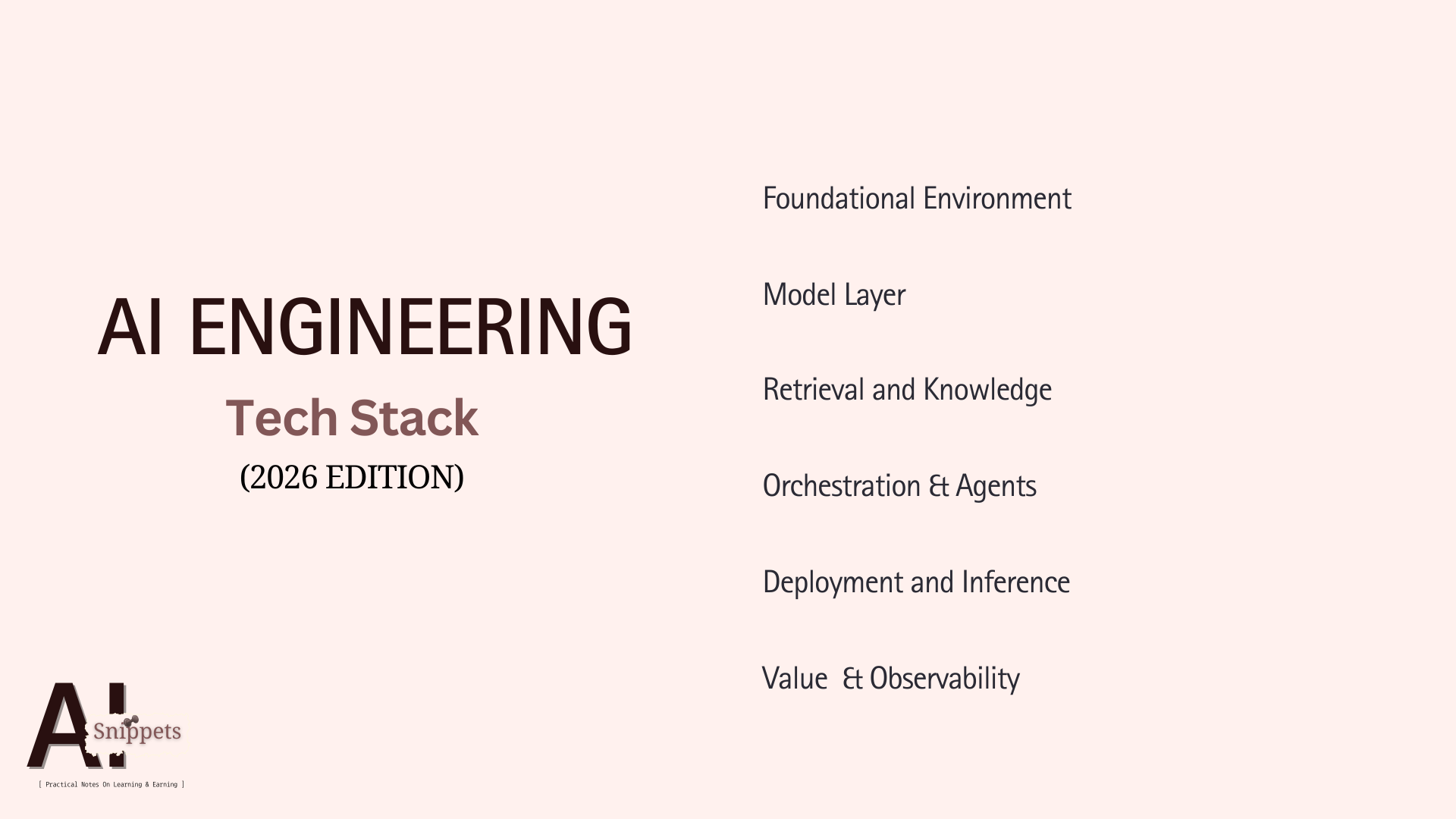
1. Foundational Environment
This is the ground layer.
It includes your programming environment, infrastructure, version control, and deployment discipline. It determines whether your work is experimental or production-ready.
Most learners underestimate this layer.
Most production failures trace back to it.
2. Model Layer
This is the intelligence layer.
It includes large language models, smaller specialized models, embeddings, and fine-tuning strategies.
In 2026, model performance differences are often marginal. The advantage rarely comes from picking the “best” model. It comes from how the model is integrated into a broader system.
Models are powerful.
They are rarely the differentiator.
3. Retrieval and Knowledge Layer
This layer connects your system to data.
It determines how external knowledge is retrieved, structured, filtered, and grounded before reaching the model.
Without reliable retrieval, even the best model hallucinates confidently.
Grounding is not optional.
It is structural.
4. Orchestration Layer
This is where systems become intelligent.
It includes how tasks are decomposed, how agents interact, how workflows adapt, and how decisions are coordinated.
In 2026, the real shift is happening here.
From model selection to orchestration design.
This layer creates impact.
5. Deployment and Inference Layer
This is where experiments become products.
It includes API design, backend services, scaling strategies, latency optimization, and cost management.
Many builders stop before this layer.
Professionals do not.
6. Observability and Value Layer
This is the accountability layer.
It includes monitoring, evaluation, governance, cost tracking, and business impact measurement.
Without this layer, systems drift.
With it, systems compound.
This is also where earning happens.
Organizations do not pay for models.
They pay for measurable outcomes.
Each layer influences the next.
If you only optimize one, you create fragility.
If you understand how they connect, you create systems.
That is the difference between building demos and engineering value.
What To Focus On (Based on Where You Are)
Understanding the stack is one thing.
Knowing where to focus is another.
You do not need to master all six layers at once.
You need to move deliberately through them.
Here is a practical way to think about it.
If you are early in your journey
Focus on:
• Understanding how data flows into a model
• Building simple end-to-end workflows
• Deploying at least one small project
Do not obsess over model benchmarks.
Do not chase every new release.
Your goal is not depth yet.
Your goal is coherence.
Build something that takes input, processes it, and produces structured output reliably.
That single loop builds intuition faster than ten courses.
If you are intermediate
You likely understand models and basic RAG.
Now shift your focus to:
• Orchestration design
• Error handling
• Evaluation strategies
• Deployment discipline
Start asking:
How does this system fail?
Where are the edge cases?
What happens at scale?
This is where you move from “builder” to “engineer.”
If you are advanced
Your focus shifts to:
• Cost optimization
• Latency management
• Monitoring and observability
• Governance and risk boundaries
• Measurable business impact
At this level, intelligence is assumed.
What differentiates you is reliability and ROI clarity.
This is where credibility scales.
A Simple Rule
If you feel stuck, you are likely over-optimizing one layer.
Move one layer up.
If you are obsessed with prompts, think about orchestration.
If you are obsessed with models, think about deployment.
If you are obsessed with building, think about value.
Growth in AI engineering is vertical, not horizontal.
You do not need more tools.
You need better layer awareness.
Why This Stack Directly Impacts Earning
AI skills alone do not generate income.
Systems do.
Most people try to monetize the model layer.
Very few monetize the stack.
That difference matters.
Companies Do Not Pay for Intelligence
They pay for:
• Reduced operational cost
• Faster decision cycles
• Automated workflows
• Risk mitigation
• Measurable efficiency gains
None of those live in the model layer alone.
They live in orchestration, deployment, and value design.
If you can explain how an AI system integrates into a business process, you are already ahead of most “AI builders.”
Freelancing Rewards System Thinkers
Clients rarely ask:
“Which model are you using?”
They ask:
“Can you automate this?”
“Can you reduce our workload?”
“Can this integrate with our current tools?”
Those are stack-level questions.
If you understand data pipelines, orchestration logic, and deployment constraints, you can price differently.
You are not selling prompts.
You are selling solutions.
Hiring Signals Have Shifted
Recruiters and technical interviewers increasingly look for:
• End-to-end system thinking
• Trade-off awareness
• Deployment clarity
• Observability awareness
Anyone can call an API.
Fewer people can explain why the architecture works.
Understanding the stack makes your portfolio stronger because it shows depth beyond experimentation.
What Actually Matters
Model capabilities will continue to improve.
Orchestration complexity will increase.
Governance requirements will tighten.
Cost optimization will matter more.
The real edge in 2026 is not knowing more tools.
It is knowing how to design reliable systems across layers.
That is what creates earning power.
This issue was not about tools.
It was about structure.
Over the next few editions, we’ll break down each layer in depth.
Once you understand the stack, you stop chasing updates.
You start designing systems.
If you’re currently building AI systems and unsure which layer you should strengthen next, reply and tell me:
What are you building?
And where do you feel stuck?
I’m working on a structured breakdown of this stack. More soon.
The layer ordering resonated, but in retail deployments I've seen it flip.
Governance and ROI doesn't come last - finance is asking for the business case before the orchestration is even stable.
Most retail AI projects I've been part of didn't collapse because the system failed technically. They stalled because nobody agreed on what "measurable outcome" meant before the build started and the stack is real.
The sequence in which it catches you is different in enterprise.
Why do you think there's been no measurable ROI for companies using genAI yet? What do you think of the studies that show personal productivity increases are negligible and don't translate to organizational success?